Chapter 1 – Breath, Unmeasured
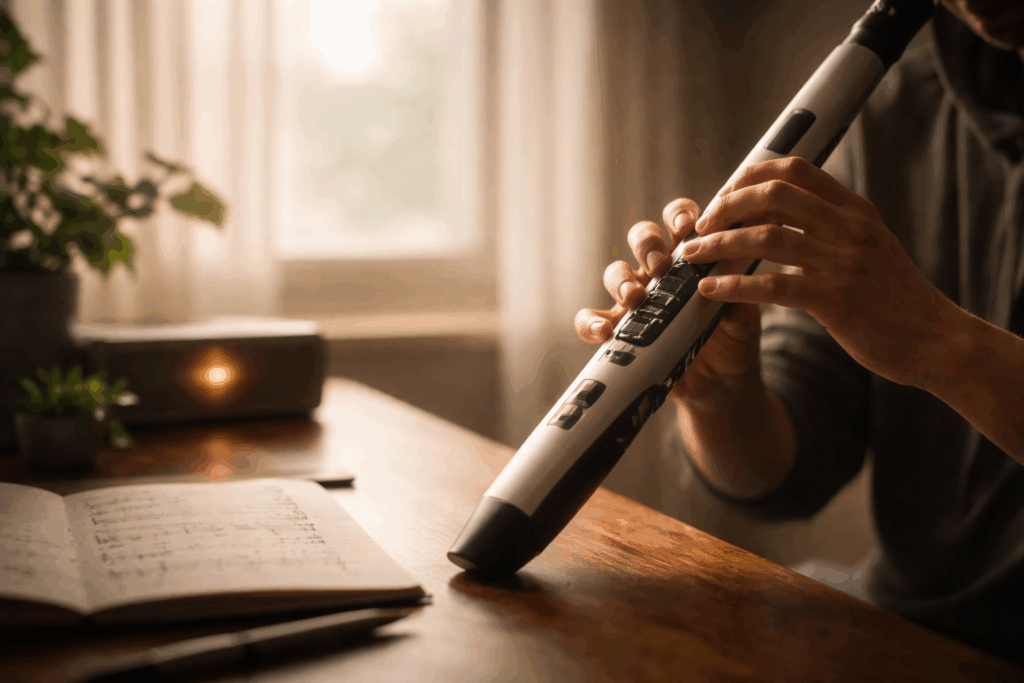
He does not warm up.
There was a time when practice began with calibration. Levels were checked. Modes were selected. Feedback was expected. Now, he simply stands by the open window and breathes, not as preparation, but as the act itself.
The instrument rests nearby, leaning where it has always leaned. It is not displayed. It does not signal readiness. It does not wait to be turned on. When he reaches for it, there is no sense of initiation-only continuation.
Breath moves first. The room responds second.
Sound enters the space without insistence. It does not fill the room so much as occupy it, briefly, then leave. Nothing records the moment. Nothing evaluates it. There is no archive accumulating progress, no trace insisting this mattered more than the last time.
He stops when the breath changes.
This is how most people use their tools now. Not to perform, not to optimize, but to regulate themselves back into alignment. The tool is not an interface; it is a boundary. It marks where intention ends and presence begins.
Outside, the city continues its quiet work. Vehicles pass without announcing their systems. Buildings adjust themselves without commentary. Information moves, but it does not ask to be seen.
Inside, the instrument returns to stillness. It does not cool down. It does not save state. It does not ask whether the session should be logged.
He sets it back where it belongs.
Later, someone else will pick it up. They will not be taught how it works. They will not be told what it is capable of. They will breathe, and the object will respond, as it always has.
This is not mastery.
It is maintenance.