Chapter 4 – What the Hand Keeps
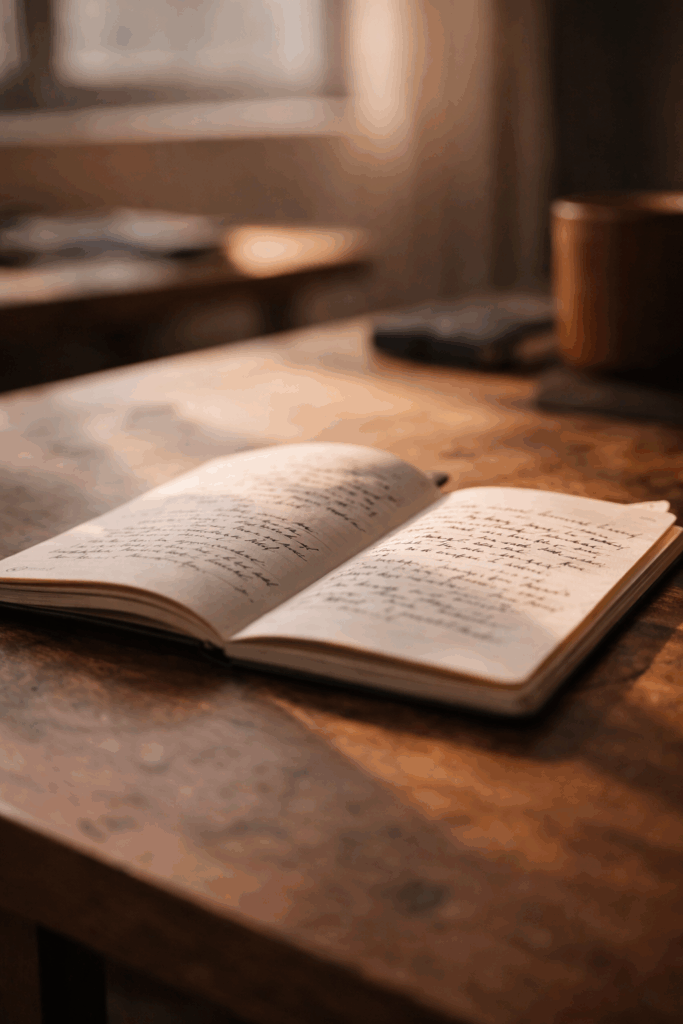
The pen is not stored.
It rests where it last stopped moving, often beside a folded page or on the edge of a table, as if it were set down mid-thought rather than put away. No case protects it. No surface presents it as special.
When it is picked up, there is no preparation.
The hand already knows the weight. The balance has been learned slowly, through repetition, not instruction. There was a time when tools like this came with choices-modes, settings, interchangeable parts meant to promise adaptability. Those were abandoned. What remains is singular.
Writing happens without capture.
The page accepts marks and keeps them. Nothing mirrors the motion. Nothing corrects spacing or smooths lines. The irregularities stay. They are not treated as errors.
Most people write less now, but they write more deliberately.
Messages move through other channels. Records assemble themselves elsewhere. Writing by hand is reserved for moments when thinking needs friction-when the delay between intention and mark matters.
The pen does not optimize that delay.
It does not guide the stroke or suggest alternatives. It does not learn from what is written. It has no interest in improvement. Its only obligation is to respond consistently, each time it is held.
Sometimes the pen is lent.
The borrower notices it briefly, the way one notices a familiar tool that happens to belong to someone else. There is no explanation offered. The marks look slightly different in another hand, but the difference is not dramatic enough to comment on.
Later, the pen is returned.
It carries nothing back with it. No history, no summary, no trace of what passed through it. The page remains where it was left, folded and slipped into a book or pocket.
Over time, the pen accumulates signs of use. Not wear that weakens it, but the kind that smooths edges and dulls surfaces. These changes are not measured. They are accepted.
In a culture that remembers everything automatically, this kind of forgetting becomes valuable.
The pen does not remember for you.
It only stays ready.